Sovereign Roots
In February 2026, the Strait of Hormuz effectively closed to agricultural shipments. For farmers thousands of miles away, the resulting market shock is a brutal tax on their operational survival. Within weeks, the purchasing power of growers in import-dependent regions like India, Brazil, and the United States plummeted. Urea prices surged 60% with phosphate markets seeing a corresponding spike higher as well. A localized naval standoff had instantly degraded the fundamental economics of global caloric production, threatening millions with food insecurity.
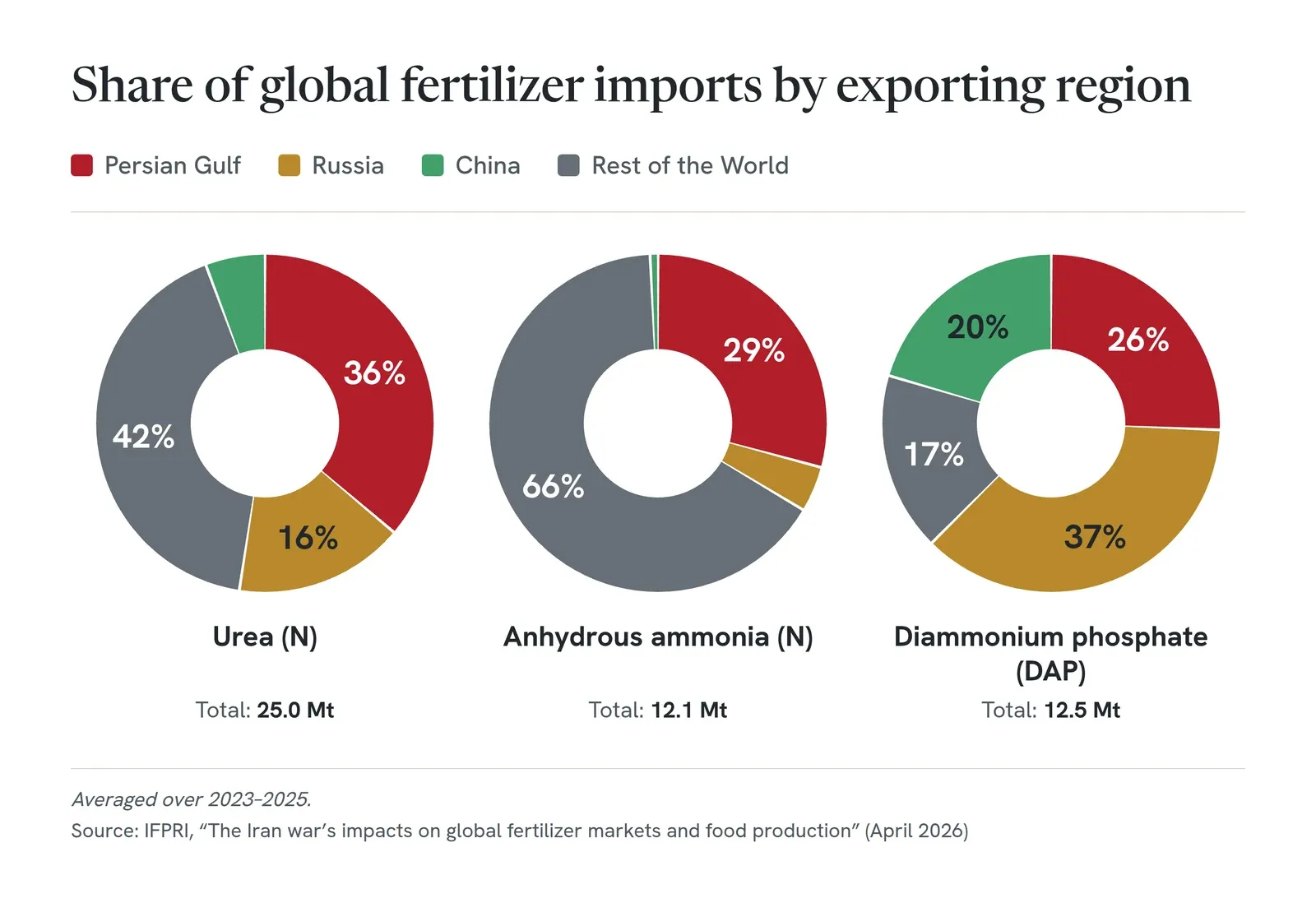
The Persian Gulf is the single largest source of imported fertilizer, supplying 36% of the world’s urea,
29% of its anhydrous ammonia, and 26% of its diammonium phosphate.
This rapid escalation exposed the fragile architecture of the modern agricultural supply chain: it operates as a hyper-vulnerable circulatory system entirely dependent on narrow maritime chokepoints and a continuous flow of synthetic chemistry.
The Architecture of Dependency
Nitrogen fertilizer synthesis is profoundly energy-intensive, requiring vast quantities of natural gas as a primary input for the Haber-Bosch process. While domestic production facilities exist worldwide, the tradable export market, and the Liquefied Natural Gas (LNG) production required to power domestic production in energy-importing nations, are heavily concentrated in the Persian Gulf and the Black Sea basin. Relocating this heavy industrial capacity rapidly in response to a crisis is impossible. A single ammonia plant requires not only direct access to raw inputs, but also rigorous regulatory approval and billions of dollars in infrastructure costs. With over 98% of global commercial farmland reliant on synthetic chemistry to sustain the yields that feed half of humanity, the global agricultural sector is forced to rely on a handful of sovereign actors and vulnerable shipping routes to supply the baseline inputs required for basic food availability.
Over a 15-year period concluding in the late 2010s, the share of internationally traded grain and fertilizers passing through at least one critical maritime chokepoint increased from 43 to 54 percent. Global agriculture is becoming increasingly dependent on corridors that are highly contested. The sheer volume of agricultural commodities transiting these narrow corridors highlights the disproportionate leverage held by localized conflicts. The Persian Gulf alone supplies over 40% of global seaborne urea exports, making it a single point of failure for global nitrogen fertilizer availability.
Furthermore, the 2026 Hormuz shock did not occur in isolation. Compounding the crisis, it layered on top of existing Chinese phosphate export curbs, which restricted up to 80 percent of China’s export volumes, and ongoing Russian Black Sea quotas. All of these taken together are creating a massive systemic bottleneck for global food security. When supply is volatile and demand is absolute, the entire supply chain becomes brittle.
When Environment Fails
Colliding with the geopolitically fragile agriculture input system is an accelerating escalation in climate-driven abiotic stress. The assumption of stationary weather patterns, the bedrock of traditional agronomic calendars, has been definitively upended. Physically-based modeling confirms that the underlying climate-attributable variance is rising rapidly per degree of warming. The physical environment is becoming fundamentally more hostile and the currently applied technological rescues are stretched to their limits.
A recent severe European heatwave destroyed millions of tonnes of grain, costing the agricultural sector billions in lost revenue. Simultaneously, extreme Plains drought resulted in the smallest US winter wheat crop since 1965, with over 60% of the acreage suffering severe drought conditions during a critical growth window.
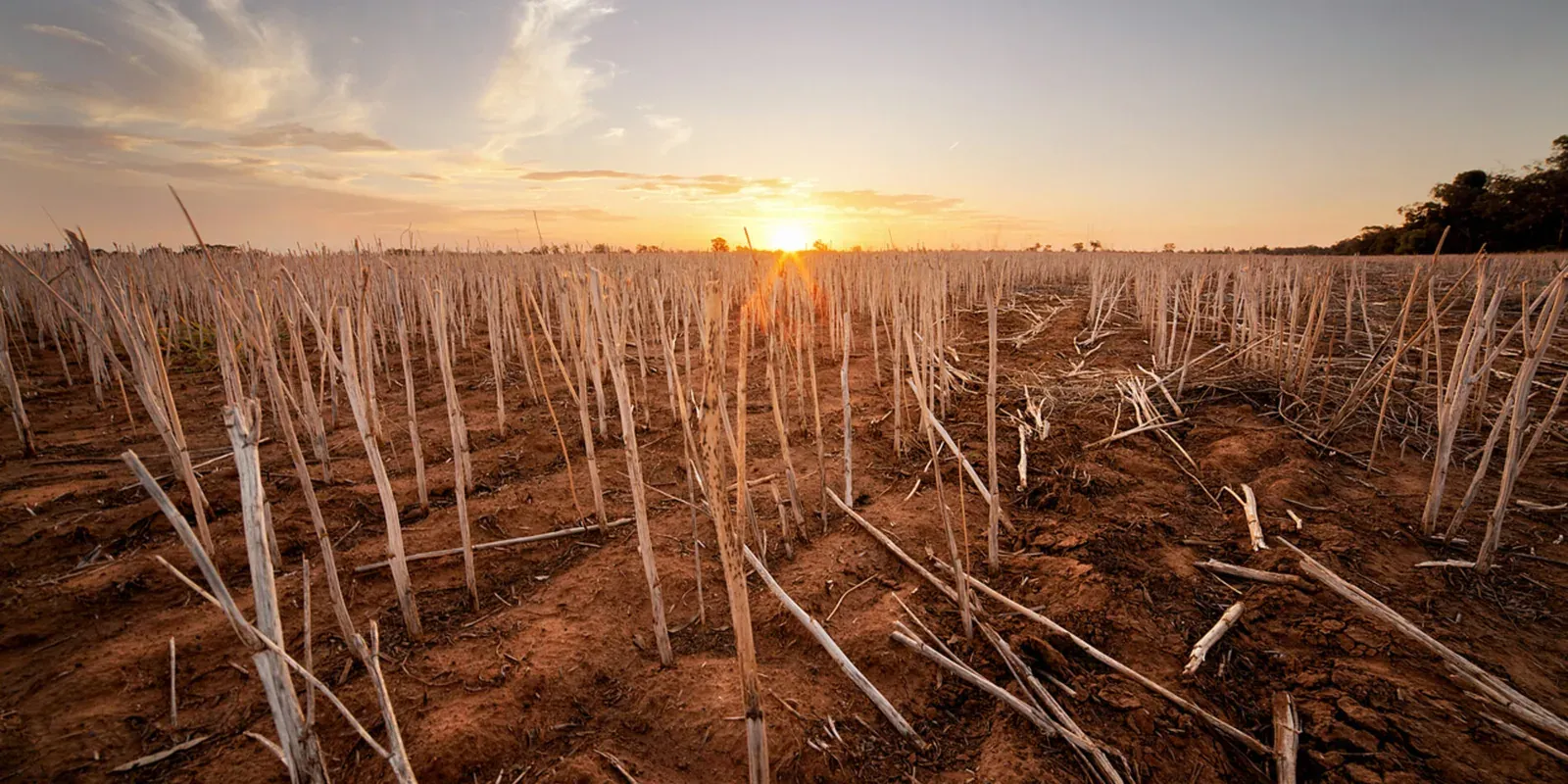
Volatile and extreme temperatures pose a critical risk for global food production.
Heightened weather variance breaks the fundamental assumption of conventional agriculture: that static chemical applications will translate into predictable yield return. When unpredictable weather strikes, the efficiency of applied synthetic fertilizers collapses.
During a sudden flash drought, soil moisture rapidly depletes, halting the mass flow and diffusion required for roots to uptake nitrogen and phosphorus. Consequently, expensive applied urea sits inert in the soil until a sudden, erratic precipitation event triggers massive leaching, washing the investment away before the stressed plant can metabolize it. Alternatively, under severe heat, surface-applied nitrogen rapidly volatilizes into the atmosphere, converting a massive capital expenditure into useless gas.
Expensive, geopolitically constrained inputs are becoming structurally less effective because erratic weather prevents stressed plants from efficiently metabolizing them. The financial risk profile for growers deteriorates rapidly because they cannot forecast whether their fertilizer purchases will yield a return or be lost to the environment.
Biophotonic Insurance
The necessary response moves away from reactive chemical application in the field to proactive physical intervention before the seed is even planted. Applying a precisely controlled light dose to seeds prior to planting, activates inherent stress resistance traits before it ever encounters the volatile weather environment and overclocks its metabolism to drive faster and stronger emergence.
Functioning as “biophotonic insurance” inscribed directly into the seed, this intervention pre-arms the crop to survive the harsh conditions, while reducing its dependency on external, increasingly vulnerable inputs. It acts as a physical hedge against macroeconomic and climate uncertainties.
Conventional agricultural systems suffer from notoriously poor Nutrient Uptake Efficiency (NUE). Even under ideal conditions, global baseline nitrogen uptake hovers below 50%. Consequently, a massive percentage of applied synthetic nitrogen is never assimilated by the crop, lost entirely to the environment. Targeted photonic stimulation significantly expands root architecture, facilitating superior uptake of macronutrients. It helps to decouple agricultural output from the application of imported chemicals, reducing the required synthetic fertilizer application without sacrificing baseline yield, and brings more control back to the local level.
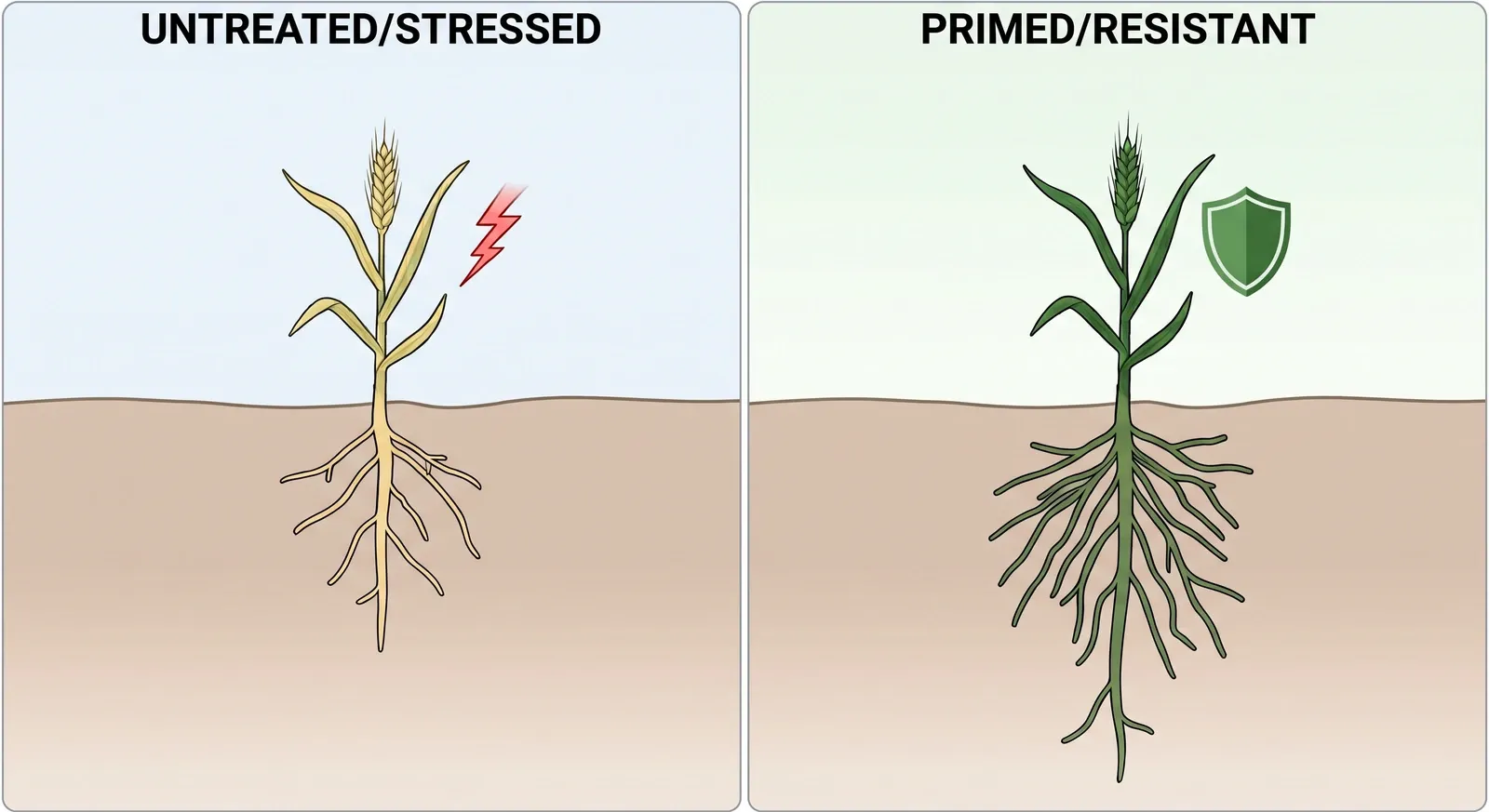
Comparison of root system development for stressed plant and a primed plant resistant to stress.
Major fertilizer producers utilize the geopolitical fragility argument to demand massive government subsidies for increased domestic production capacity, attempting to solve a dependency problem by subsidizing the dependency. Concurrently, legacy seed companies focus entirely on long-cycle genetic modifications that take a decade to reach the field. True resilience calls for structurally reducing fertilizer demand by increasing its efficiency, not subsidizing fragile supply chains or waiting for the next generation of transgenic traits.
While the NUE boost counters the global supply chain constraints, stress resistance imprinted into epigenetic memory defends against the increasingly volatile growing conditions. Prior to the onset of environmental trauma, the intervention upregulates critical antioxidative defense pathways. The seed starts manufacturing the necessary enzymes before the real stress event even occurs. Instead of shutting down vegetative growth to survive, the plant maintains stability of its baseline photosynthetic activity against deteriorating conditions.
Engineering Sovereignty
We live in times of increasingly necessary adaptation of global agriculture. The reality forces a structural shift from simply managing chemical inputs to optimizing inherent biological capacity, engineering sovereignty through resilience and altering the risk profile of global food production.
Revisiting the Hormuz shock highlights the strategic value: if a nation can reduce its reliance on imported synthetic inputs, it fundamentally alters its exposure to maritime blockades and geopolitical leverage. This is sovereign resilience engineered at the biological level, insulating domestic food supplies from distant naval conflicts.
On top of geopolitical turmoil, weather variance risks keep stacking. Extended periods of cold or hot weather, rapid high amplitude swings of temperature, and erratic precipitation patterns all compound, disrupting healthy plant growth and causing billions of dollars of revenue in losses driven by lower yields.
Crucially, laser seed priming is an orthogonal technology. It does not demand that a grower abandon their current agronomic stack, but it acts as a multiplier on existing investments. It is non-competing with transgenics and overlapping with existing seed treatments. While it acts as an insurance against unstable weather and fertilizer shortage, it also helps extract higher efficiency from whatever regimen the grower is already deploying.
True agricultural security cannot be achieved by finding new sources for the same fragile inputs or merely hoping for predictable weather patterns. The physical environment and the geopolitical landscape have permanently shifted. At Chromavia, we believe that decoupling yield stability from chemical dependency through optimizing existing biochemical pathways is a critical path forward for a volatile world.